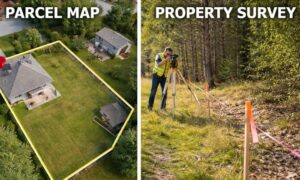
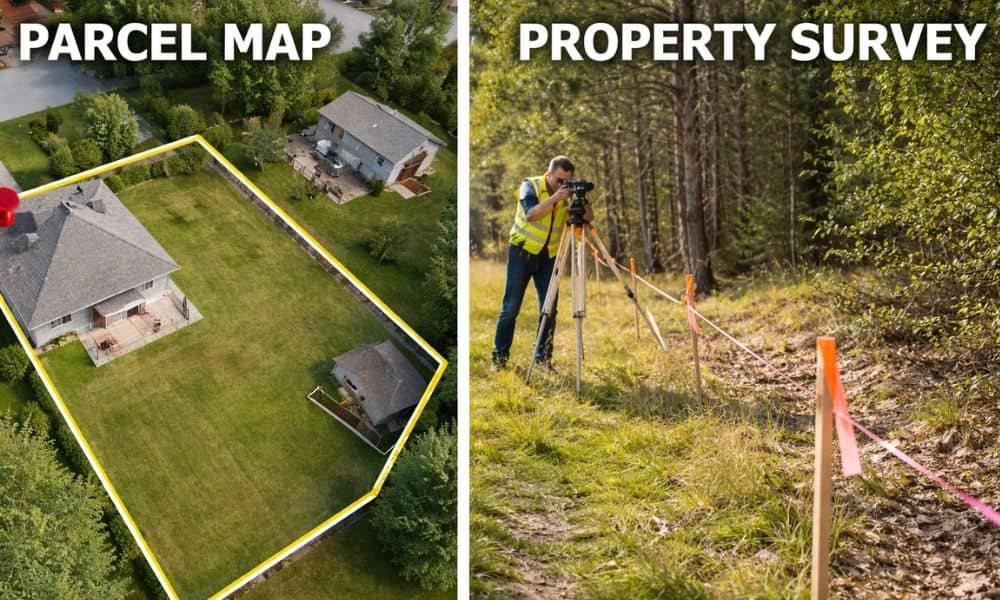
You pull up your property online. The lines look clear. Everything seems simple. So you start planning. Maybe it’s a fence. Maybe a shed. Maybe you just want to know where your yard really ends. At first, the map gives you confidence.
But then something feels off.
A contractor asks for exact measurements. A neighbor questions where the line actually sits. Or a permit reviewer tells you the layout needs verification. Suddenly, that clean map does not feel so reliable anymore.
This is where many homeowners run into trouble. They rely on a parcel map when what they really need is a property survey. It’s only later, usually after questions start piling up that they see how property surveys confirm boundary lines in a way those maps never really could.
Why Parcel Maps Feel Like the Right Answer
Parcel maps are easy to find. You can open them in seconds. They look official, neat, and complete. Because of that, they feel trustworthy.
Also, they show just enough to make decisions seem easy. You see your lot shape. You see boundary lines. You see how your property sits next to others.
So naturally, many homeowners use them as a guide when planning changes.
However, that’s where the confusion begins.
The map feels exact, but it is not meant to be.
What Most Owners Don’t Realize About Parcel Maps
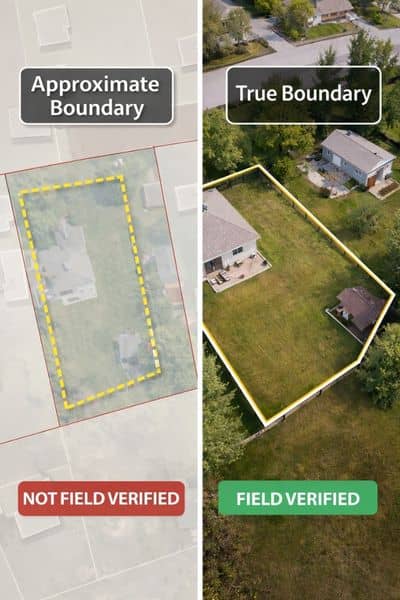
At a glance, parcel maps look precise. Still, they are not built from measurements taken on your property today. Instead, they come from recorded data that may be old, adjusted, or simplified.
Because of that, the lines you see are only an estimate of where boundaries should be.
They do not confirm what is actually on the ground.
They also do not show small but important details. For example, they may miss how close a structure sits to a boundary. They may not reflect slight shifts over time. And they often leave out conditions that affect how your land can be used.
So while the map helps you understand the general layout, it cannot give you full certainty.
That gap is where mistakes start.
How a Property Survey Changes Everything
A property survey works very differently.
Instead of relying on general data, a licensed professional measures your land directly. They connect legal records with real-world conditions and mark the true boundaries on-site.
That’s when things start to line up. You’re not guessing anymore or going off what looks right, you’re looking at what’s actually been checked. You start to see what a property survey actually confirms, and it’s usually not exactly what the map made it seem.
And that shift matters more than most people expect. Even a small difference in boundary location can change where you build, place, or plan.
Where Small Assumptions Turn Into Bigger Problems
Most issues do not start with big mistakes. They begin with small assumptions.
For example, a homeowner may follow the map when laying out a fence. The line looks straight, so the fence goes up without concern. Later, they find out the true boundary sits a few feet away.
In another case, someone places a shed based on what they see online. Everything fits on the screen. Yet on the ground, the space is tighter than expected.
Sometimes, the problem is not obvious at first. The project looks fine. However, once real measurements come into play, adjustments become necessary.
These situations feel frustrating because they could have been avoided early.
Why This Happens More Often in Bowling Green
Bowling Green continues to grow, and with that growth comes more property improvements. Homeowners update spaces, add structures, and make changes to how they use their land.
At the same time, digital tools make it easier than ever to access property information.
So people rely on what they can see quickly.
However, not all properties behave the same way. Some lots have older records. Some have been modified over time. Others have details that do not show clearly on a map.
Because of this, what looks simple on a screen may not match reality.
That difference becomes more noticeable as more people start building and improving their properties.
When a Property Survey Becomes the Smarter Choice
Not every situation calls for detailed measurement. Still, there are moments when accuracy matters more than convenience.
When you plan to place something near a boundary, even a small shift can affect your layout. When spacing matters, estimates are not enough. And when your project depends on exact positioning, guessing creates risk.
In these cases, a property survey gives you clarity before you move forward.
Instead of adjusting later, you start with the right information.
That approach saves time, avoids confusion, and keeps your plans on track.
How to Approach Property Planning the Right Way
The key is not to avoid parcel maps. They still serve a purpose. They help you understand the general shape and layout of your property.
However, they should not guide final decisions.
When your plans move from idea to action, it helps to slow down and confirm what is actually there. Bringing in accurate measurements early makes everything smoother.
Contractors work better with clear information. Layout decisions become easier. And you avoid second-guessing your choices.
Because of that, the process feels more controlled from start to finish.
The Difference That Matters Most
A parcel map gives you a picture.
A property survey gives you certainty.
At first, that difference may not seem important. Yet once you begin planning changes, it becomes clear why accuracy matters.
Even a few feet can affect how your space works.
So before you rely on what you see online, take a moment to ask whether that information is enough. If there is any doubt, getting a property survey helps you move forward with confidence.
Final Thoughts
Many homeowners start with the same step. They check their property online and begin planning from there.
That step is useful, but it should not be the last one.
When decisions depend on real boundaries, verified information makes all the difference. A property survey connects your plans to what actually exists, not just what appears on a screen.
In the end, it is not about adding extra work.
It is about making sure everything lines up the way it should—before anything gets built.