How To Find Your Property On FEMA’s Flood Insurance Rate Maps

What are FEMA flood maps?
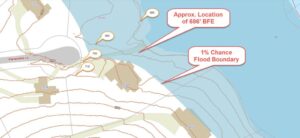
FEMA’s Flood Insurance Rate Maps (FIRMs) or just Flood Maps are provided after a flood risk assessment has been completed or updated for a community.  This study is known as a Flood Insurance Study.  The FIRM gives you the Base Flood Elevations (BFEs) and insurance risk zones in addition to floodplain boundaries.  The FIRM may also show a delineation of the regulatory floodway.

Once the “insurance risk zone”  (commonly referred to as the flood zone) is determined, actuarial rates, based on these risk zones, are then applied for newly constructed, substantially approved, and substantially damaged buildings.  FEMA uses these rates to determine the insurance rate you will pay for flood insurance

FEMA’s Digital Flood Maps

FEMA discontinued the production and distribution of paper flood maps in 2009 as part of its Digital Vision Initiative. This affected all the Flood Maps, boundary information, and study reports. However, clients can still view the products for free through their website or buy them in digital format.

To view these flood maps online, go to FEMA’s Map Service Center and key in your address (hi-lited area shown here) search for your home.  This will prompt you to then select the map that covers your area.  The Flood Maps are somewhat cumbersome to use online. It is best to go through the tutorial on the bottom right of the address search page for an easier and more effective use of the GIS map.


author avatar
Surveyor

More Posts

Aerial view of a commercial property with parking areas, access roads, and surrounding open land
alta survey
Surveyor

How the 2026 ALTA Survey Standards Changed From 2021

Your survey request template, lender checklist or closing guide may still point to the 2021 ALTA survey requirements. If so, it’s probably out of date. ALTA and NSPS replaced the 2021 edition with new standards that took effect on February 23, 2026. Most of the update tightens wording and leaves

Read More »
Homes along the edge of an agricultural field, where a residential survey helps define the boundary between the properties
land surveying
Surveyor

Residential Survey for Homes Along Agricultural Tracts

Some homes sit right where the neighborhood stops and the farmland starts. The city splits Fayette County into an Urban Service Area and a Rural Service Area, so a backyard can end at a hayfield, a cattle pasture or a horse paddock. If you plan to build, plant or fence

Read More »
Indoor equestrian arena with a sand riding surface and covered structure for construction staking work
construction
Surveyor

Construction Staking Survey for Equine Training Facilities

An equine training facility packs a lot onto one piece of ground. Arenas, barns, wash racks, walking paths and trailer drives all have to land where the approved site plan puts them. A construction staking survey carries that plan from paper to the field. A licensed surveyor sets stakes and

Read More »
Aerial view of a tree-lined depression near roads and buildings, illustrating how LiDAR mapping can help identify potential sinkhole areas during karst site planning
drone surveying
Surveyor

Can LiDAR Mapping Support Karst Terrain Site Planning?

Yes. LiDAR mapping can support karst terrain site planning by showing shallow dips and closed low spots that are hard to see from the ground. It works best as an early planning tool that points your team to the places that need closer study. In Bowling Green, limestone sits under

Read More »
Surveyor measuring ground elevations at a construction site
elevation certificate
Surveyor

Elevation Certificate vs. Site Elevation Data for Construction Planning

If you already have an elevation certificate for a property, you might think that document covers what your builder or engineer needs. Sometimes it does. Often it doesn’t. You may not notice the gap until a plan reviewer or contractor asks a question the certificate can’t answer. An elevation certificate

Read More »